
Brand Code: Why distinctive fashion brands need a system behind their product
Brand Code defines the product decisions that make your fashion brand distinctive, recognisable and hard to imitate.
Fashion is not short of inspiration. It is drowning in it. Runway imagery lands instantly, trend intelligence is everywhere, social feeds collapse global aesthetics into the same visual stream and AI can generate another hundred directions before a team has properly interrogated the first. The result is not necessarily better fashion; increasingly, it is more product built from the same inputs, processed at the same speed and arriving at surprisingly similar conclusions. The harder competitive problem is no longer finding enough ideas. It is knowing which ideas deserve to enter your collection, which should be pushed further and which should be rejected because they weaken the thing that makes the brand worth choosing in the first place. That is the territory Brand Code is built to address.
A point of view is an editing system
Distinctive brands are not defined by how much they absorb from the market, but by how aggressively they edit it. They know that a strong trend can still be wrong for them, that a commercially attractive product can dilute the wider collection and that not every opportunity deserves development simply because the customer might buy it. This is where a point of view stops being an abstract creative ambition and starts becoming operational. It lives in the repeated choices around proportion, material, construction, detail, restraint, tension and value that make one option feel right and another feel immediately out of place. When those decisions remain instinctive and undocumented, they become vulnerable to pressure from new hires, seasonal trends, commercial demands and the perfectly reasonable desire to keep moving. Brand Code takes that instinct and makes it usable.

Strong brand codes are not surface signatures added to a collection. They shape the way proportion, material, construction and detail are handled before the product ever reaches the customer.
The market should influence the brand, not rewrite it
Trend intelligence matters because fashion cannot evolve in isolation, but the same trend should never produce the same answer across every brand. A movement towards softer tailoring, for example, should look different at a brand built around severity than at one built around sensuality, utility or decorative excess. Price point changes fabrication, construction and finish; customer changes proportion and functionality; established codes determine what should be amplified, resisted or translated. Without that internal filter, forecasting can become a route to sameness because teams see the same signal and move towards the same obvious expression. The stronger question is not simply what is changing? but what does this change become once it passes through us? That is where an external trend becomes distinctive product rather than another market response.
Recognition is built below the surface
A logo can identify a brand, but it cannot create a distinctive product language on its own. That comes from deeper repetition: a particular relationship between structure and softness, the way volume is controlled, a material combination that keeps returning, a recognisable treatment of detail or a tension the brand continually revisits without resolving in exactly the same way. These elements are powerful because they can move. They do not require the same bag, coat or shoe to be repeated forever; they give the team a set of principles capable of generating different products while maintaining continuity between them. The strongest fashion brands are therefore not consistent because everything looks the same. They are consistent because enough of the underlying decisions come from the same system.
BUILD A BRAND THAT STANDS APART
Brand Code
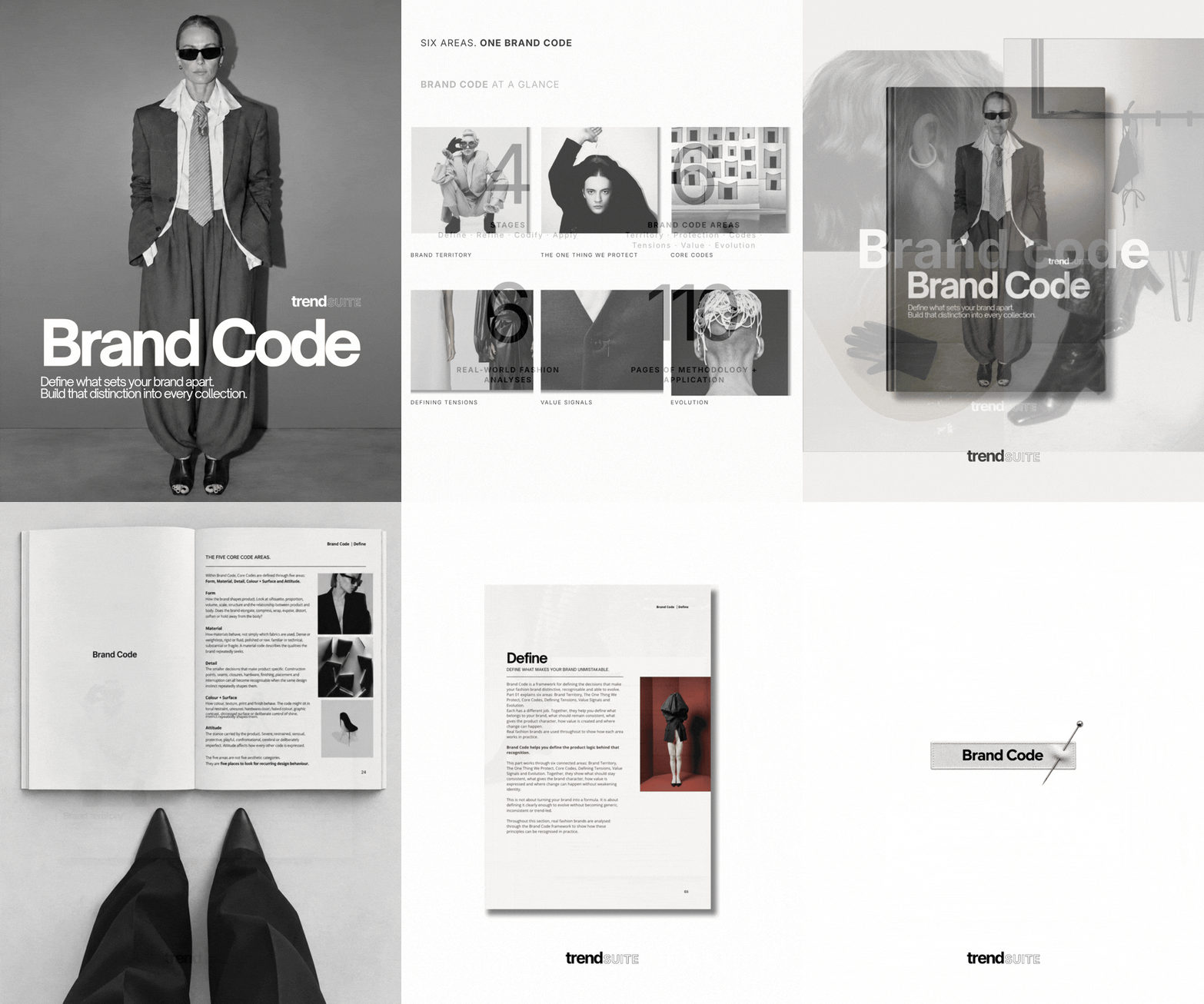
Brand Code is a fashion-specific methodology for founders, designers and teams who already have a brand and want to define what sets it apart, make stronger product decisions and build greater distinction into every collection.
The 110-page digital book moves through four stages — DEFINE, REFINE, CODIFY and APPLY — across six core areas: Brand Territory, The One Thing We Protect, Core Codes, Defining Tensions, Value Signals and Evolution. It includes practical exercises, six real-world fashion brand analyses and a six-part guided email series that supports you as you work through the methodology.
This is not another branding book about logos, typography, tone of voice, mission statements or customer personas. It deals with the creative and product decisions underneath the brand: what deserves to stay, where tension creates character, what signals value to your customer and how the brand should evolve without becoming generic.

Brand Code
Brand Code is a four-part fashion methodology for defining, codifying and applying the creative and product logic that makes your brand distinctive, recognisable and relevant.

What you reject matters as much as what you make
The strongest design teams are not simply good at generating ideas; they are good at killing the wrong ones. That becomes much harder when the criteria live only inside one founder or creative director’s head, because every decision has to be re-argued from scratch and every new influence has the potential to expand the brand a little further until the original territory becomes difficult to see. A defined Brand Territory, Core Codes and Defining Tensions create useful boundaries around that process. They allow teams to say no for a reason, not because something is inherently bad, but because it belongs to somebody else. In a market where access to information is increasingly equalised, the discipline to reject becomes one of the few advantages that cannot simply be copied from the same reference folder.
Evolution needs something solid to push against
A brand without defined codes can mistake change for progress because almost any new direction feels like evolution. A brand with a stronger internal system can make a much more demanding distinction between change that deepens the proposition and change that merely makes the collection look different. This is why Brand Code includes Evolution as part of the methodology rather than treating consistency as the end goal. The objective is not to freeze a successful formula or protect familiar product forever; it is to identify what should remain stable enough that everything else can move with greater freedom. When the core is defined, experimentation becomes less dangerous because the team knows which parts of the brand can stretch, where newness should enter and which decisions would remove too much of what customers already value.
Final perspective: Brand Code
Fashion has more access, more reference material, more trend information and more ways to generate new ideas than at any previous point. That abundance should be producing more difference. Too often, it is producing more sameness.
The answer is not another moodboard, another trend report or another seasonal aesthetic layered on top of an undefined brand. It is a stronger filter between everything the market offers and what your collection actually needs.
That is what Brand Code is for.
It defines the territory you are operating in, the thing worth protecting, the codes customers learn to recognise, the tensions that keep the brand interesting, the signals that communicate value and the rules for evolving all of it without flattening the identity underneath.
More ideas are easy.
Knowing which ones belong is the work.
THE COLOUR SIGNALS BRANDS WILL BE BACKING FOR SS28
FREE SS28 Colour edit
A free edit of five colour signals beginning to shape Spring Summer 2028 womenswear.
From humanised neutrals and purposeful pales to stranger greens, fluid blues and measured brightness, this is the early read for brands deciding what deserves space next.
Use it to sharpen palette direction, challenge the obvious and start SS28 with a stronger point of view.

Choose how you forecast

The Forecast Library
Focused direction when you need it.
Individual fashion trend forecasts for brands that need focused direction across colour, macro trends, print, silhouette, materials and key product categories.
Choose the season and category relevant to your collection, with clear intelligence designed to help you understand what is shifting and turn emerging signals into sharper product decisions.

Join Innovator Elite
The complete Trend Suite forecasting system.
For brands and product teams that need the full view. Access the Forecast Library, every new release, Colour Lab, Macro Trends, Micro Trends, Design Directions and practical resources in one connected platform.
Built for continuous access across seasons and categories, so your forecasting intelligence stays connected rather than pieced together.


