
If the logo disappeared, would your fashion brand identity still be recognisable?
The strongest fashion brand identity lives in the product itself, through the proportions, materials and details customers recognise before they read the label

Remove the logo from most fashion products and something uncomfortable happens: much of the brand disappears with it. The garment may still be attractive, well made and commercially viable, but there is often very little within the product itself that identifies who designed it. That is the difference between having a visual identity and having a recognisable product language. Logos, typography, campaign imagery and packaging can tell the customer whose product they are looking at, but a distinctive fashion brand identity should already be present before any of those signals arrive. It exists in the decisions that keep resurfacing across collections — how the brand uses proportion, where tension appears, which materials recur, how details are handled and which parts of the creative language remain consistent even while the product changes.
Recognition is built through product behaviour
The brands we recognise most quickly rarely depend on one isolated design feature. Their identity is built through recurring product behaviours that create a sense of familiarity even when the individual garment is new. Form may consistently be elongated, compressed or oversized; materials may carry a particular relationship between refinement and rawness; details may be exaggerated, removed or placed in recognisable ways; colour may behave with a particular restraint or intensity; and the overall attitude may remain controlled, disruptive, sensual or severe. These are not seasonal trends layered onto the collection. They are the underlying creative rules that make different products feel as though they belong to the same world. The stronger those rules become, the less the brand needs to explain itself externally because recognition has already been embedded within the product.

Maison Margiela’s Tabi demonstrates what happens when a product detail becomes a genuine brand code: the split toe remains recognisable even when the name, logo and wider campaign language are removed. The Tabi has been continually reinterpreted since its introduction in the Maison’s debut collection in 1989.
The problem is not a lack of ideas
For many brands, the harder question is not what to design next but which ideas actually belong. Fashion teams have access to an extraordinary volume of references, seasonal intelligence, competitor activity and emerging aesthetics, which means generating another possible direction is rarely the difficult part. The challenge is determining which ideas strengthen the brand and which merely make the collection look current. Without a defined internal logic, every new season can become an opportunity to reset, adding a different silhouette, material language or aesthetic simply because it appears relevant. Over time, the brand may continue producing good product while becoming progressively harder to recognise. Distinctiveness therefore depends as much on exclusion as creation: knowing what the brand protects, what it rejects and which changes can be absorbed without weakening the identity underneath.
Recognition without repetition
Consistency does not mean reproducing the same successful product indefinitely. In fact, literal repetition can become just as damaging as constant reinvention because it turns a recognisable code into a formula. The stronger approach is to separate what is fixed from what can evolve, allowing the permanent logic of the brand to remain visible while its expression changes. A familiar proportion can be disrupted, an established material relationship can enter another category and a recurring detail can shift scale or position without losing its connection to the original code. This is how a fashion brand develops recognition without becoming repetitive: the customer senses continuity, but the design team still has enough creative freedom to move the product somewhere new.
IF THE LOGO DISAPPEARED, WHAT WOULD BE LEFT?
Brand Code
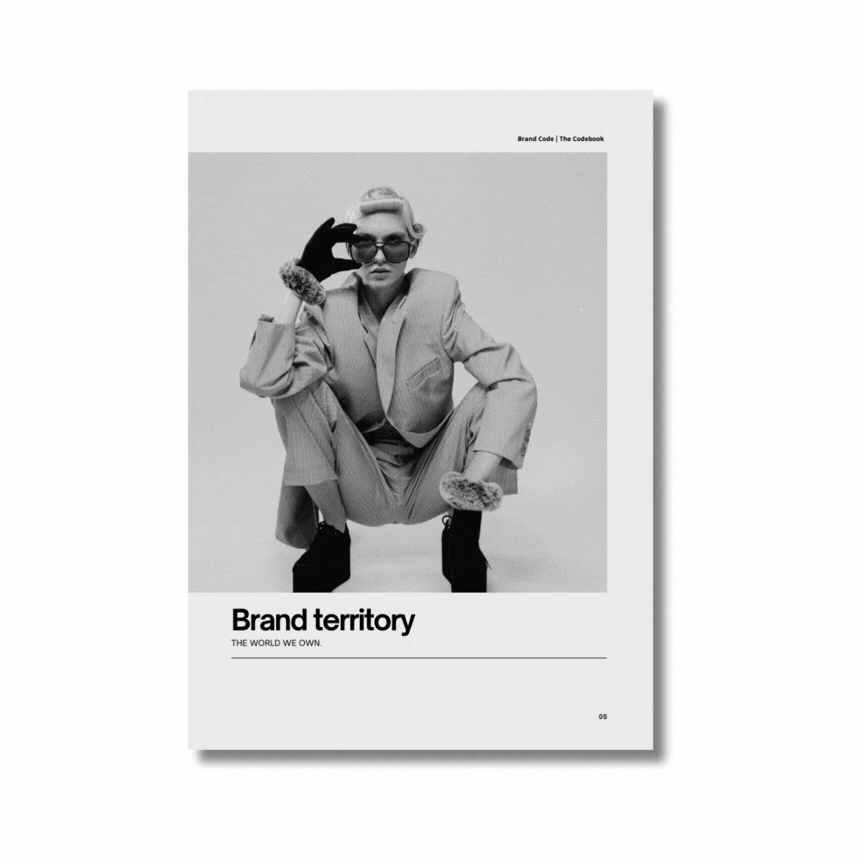
Brand Code is a four-part methodology for founders, designers and teams who already have a fashion brand, product language or established creative instinct and need to define what makes it recognisable enough to protect and flexible enough to evolve.
It is not a branding book about logos, typography, tone of voice, customer personas or mission statements. The System, Workbook, Codebook and Code Sheet help define the creative and product logic underneath the brand — from Brand Territory and Core Codes to Defining Tensions, Value Signals and what should remain fixed, evolve or introduce newness from one collection to the next.
The goal is simple: recognition without repetition.

Brand Code
Brand Code is a four-part fashion methodology for defining, codifying and applying the creative and product logic that makes your brand distinctive, recognisable and relevant.
Your codes should survive a new season
The real test of a brand code is whether it can generate something new rather than merely preserve something old. A useful code should give the design team a framework for making decisions when the product changes: whether a new silhouette still feels credible, whether an unfamiliar material strengthens the existing language and whether a seasonal trend can be translated without overwhelming what already makes the brand distinctive. This is why identifying the code is only the beginning. It also requires understanding the tensions that keep the brand interesting, the value signals customers need to perceive and the boundaries between what should remain fixed and where experimentation is necessary. When those decisions are explicit, evolution becomes more deliberate because the team is no longer relying on instinct alone to decide whether something still belongs.
The strongest brands know what they refuse
Recognisability is created as much by what a brand leaves out as what it repeatedly includes. A defined point of view establishes boundaries around the collection, making certain silhouettes, materials, details or ways of styling feel naturally right while others remain outside the brand regardless of how commercially attractive or culturally visible they become. Those exclusions are not restrictions on creativity; they concentrate it. When teams know what the brand will not become, they can push much further inside the territory that remains, finding new expressions of familiar tensions rather than continually widening the aesthetic until nothing feels proprietary. In a market where access to references is becoming almost universal, that ability to edit becomes increasingly important because the competitive advantage is no longer simply having good ideas. It is knowing which ideas could only belong to you.
Final perspective: Fashion brand identity
A recognisable fashion brand is not created by placing the same logo across enough products. It is created when enough of the underlying decisions repeat that the customer begins to recognise the hand behind the product before being told whose hand it is.
That recognition can live in a shoulder line, the way fabric falls, the relationship between polish and imperfection, the treatment of colour or a recurring detail that changes without disappearing. None of these elements needs to remain static, but together they create a system strong enough for the product to evolve without losing its identity.
That is the real question Brand Code is designed to answer: not how do I make my brand look consistent?, but what makes this unmistakably ours — and how do we keep evolving it without losing the thing people recognise?
Choose how you forecast

The Forecast Library
Focused direction when you need it.
Individual fashion trend forecasts for brands that need focused direction across colour, macro trends, print, silhouette, materials and key product categories.
Choose the season and category relevant to your collection, with clear intelligence designed to help you understand what is shifting and turn emerging signals into sharper product decisions.
Join Innovator Elite
The complete Trend Suite forecasting system.
For brands and product teams that need the full view. Access the Forecast Library, every new release, Colour Lab, Macro Trends, Micro Trends, Design Directions and practical resources in one connected platform.
Built for continuous access across seasons and categories, so your forecasting intelligence stays connected rather than pieced together.


